
The Living Thread of Arts: How Creativity Shapes Culture, Community, and Change
What We Mean by “Arts”
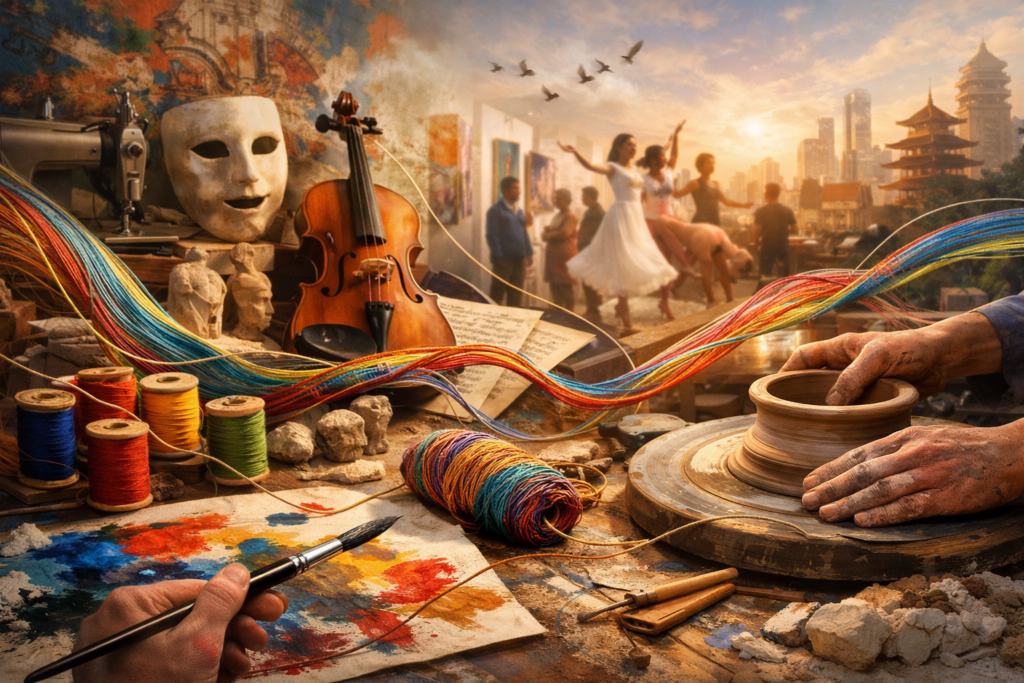
The arts are the many ways humans translate experience into form—sound, movement, image, story, and space. They include traditional domains such as painting, sculpture, music, dance, theater, literature, architecture, and film, as well as newer practices like digital art, interactive installations, and multimedia performance. While styles and technologies change, the core purpose remains steady: the arts help people communicate what is difficult to measure—feeling, belief, memory, critique, wonder, and hope.
Unlike purely utilitarian objects, artworks invite interpretation. A song can be a personal confession and a public anthem. A photograph can be evidence, poetry, and propaganda depending on context. This openness is not a flaw; it is a feature that makes art adaptable across cultures and generations.
Major Art Forms and What They Offer
Visual Arts
Visual arts encompass drawing, painting, printmaking, sculpture, photography, ceramics, and design. They are often associated with images and objects, but their real power lies in how they organize attention. Visual artists decide what to highlight, what to obscure, and what scale, color, or texture will carry meaning.
- Painting and drawing can capture gesture and mood with minimal materials.
- Sculpture and ceramics emphasize touch, weight, and the relationship between the body and space.
- Photography navigates a tension between documentation and interpretation.
- Graphic and product design connect beauty with function, shaping daily choices from signage to apps.
Performing Arts
Performing arts—music, theater, dance, opera, spoken word—exist fully in time. Even when recorded, they retain a sense of presence: the “now” of a performance, the shared focus of an audience, the risk of imperfection. This makes performing arts uniquely suited to exploring relationships: between characters, between performer and viewer, and among people gathered in one place.
- Music expresses structure and emotion through rhythm, harmony, and timbre.
- Dance turns the body into a storytelling instrument, communicating without speech.
- Theater tests empathy by placing audiences inside dilemmas and perspectives.
Literary Arts
Literature—poetry, fiction, nonfiction, plays, and essays—builds inner worlds through language. The literary arts train attention to nuance: tone, metaphor, point of view, and the politics of who gets to speak. A novel can make distant histories feel immediate; a poem can compress a lifetime into a few lines.
Film, Media, and Digital Arts
Film and media arts combine image, sound, editing, and performance. Digital arts expand the toolkit further, using animation, generative algorithms, virtual reality, game design, and interactive systems. These forms are notable for collaboration and scale: a single work may involve writers, programmers, cinematographers, sound designers, and actors. Digital tools also change access, allowing independent creators to distribute work globally and audiences to respond in real time.
Architecture and Spatial Arts
Architecture is often called “frozen music,” but it is also social engineering: it shapes where people gather, how they move, and what they value. The design of a school influences learning; the design of a park influences community life; the design of housing influences health and belonging. Spatial arts—landscape design, urban planning, installation art—remind us that aesthetics are not separate from ethics.
Why Arts Matter: Personal and Social Functions
Arts as Emotional and Cognitive Tools
People turn to art to process complex feelings—grief, joy, anger, uncertainty—because art can hold contradiction. Music can express heartbreak with beauty; comedy can illuminate pain without denying it. On a cognitive level, art strengthens skills like pattern recognition, close observation, and imaginative problem-solving. It teaches that there is often more than one “right” answer, and that meaning can be negotiated rather than fixed.
Arts as Cultural Memory
Artworks are containers of collective memory. They preserve languages, rituals, and local histories that might otherwise vanish. Murals map neighborhoods. Folk songs record migration and labor. Films archive fashions, slang, and social tensions. By studying arts, we gain insight into how people understood their world—and how they resisted, adapted, or dreamed beyond it.
Arts as Civic Dialogue and Critique
Arts can be celebratory, but they can also be confrontational. Satire exposes hypocrisy; documentary theater raises questions about power; protest posters turn streets into galleries of dissent. Because art communicates through symbolism and experience, it can reach audiences that political arguments alone might not. In healthy societies, the arts provide a space where difficult conversations can happen with depth and nuance.
How Arts Evolve: Tradition, Innovation, and Technology
Art traditions do not disappear; they transform. New tools often spark new aesthetics: oil paint changed portraiture, photography redefined realism, sampling reshaped music, and AI-assisted tools are now challenging assumptions about authorship. Yet innovation is not only technological. It can be a new point of view, a new audience, or a new purpose—for example, community-led arts projects that prioritize participation over prestige.
At the same time, arts raise practical questions: Who funds culture? Who is represented? Who benefits from creative labor? Sustainable art ecosystems depend on fair pay, accessible venues, education, and policies that protect both creators and audiences.
Ways to Engage With Arts in Everyday Life
Engaging with arts does not require expertise. It requires attention and curiosity—two resources that grow with use. Small habits can build a lasting relationship with creativity.
- Visit local culture: Attend a student recital, community theater, gallery opening, or open-mic night.
- Build a “slow looking” practice: Spend five minutes with a single artwork and notice details before reading labels or reviews.
- Create without pressure: Sketch, write, dance, or photograph for process rather than performance.
- Support artists directly: Buy tickets, subscribe to newsletters, commission work, or share credit when reposting online.
- Learn the context: Read an artist statement, interview, or history to understand the choices behind the work.
Conclusion: Arts as a Shared Human Resource
Arts are not a luxury added after “real life” is handled; they are part of how people make life intelligible. They help individuals articulate identity, help communities imagine futures, and help societies remember, question, and heal. Whether encountered in a museum or on a street corner, in a concert hall or on a phone screen, the arts offer a durable gift: the ability to see more, feel more, and connect across difference.
