
How the Pixel Evolved: From Blurry Dots to Invisible Marvels
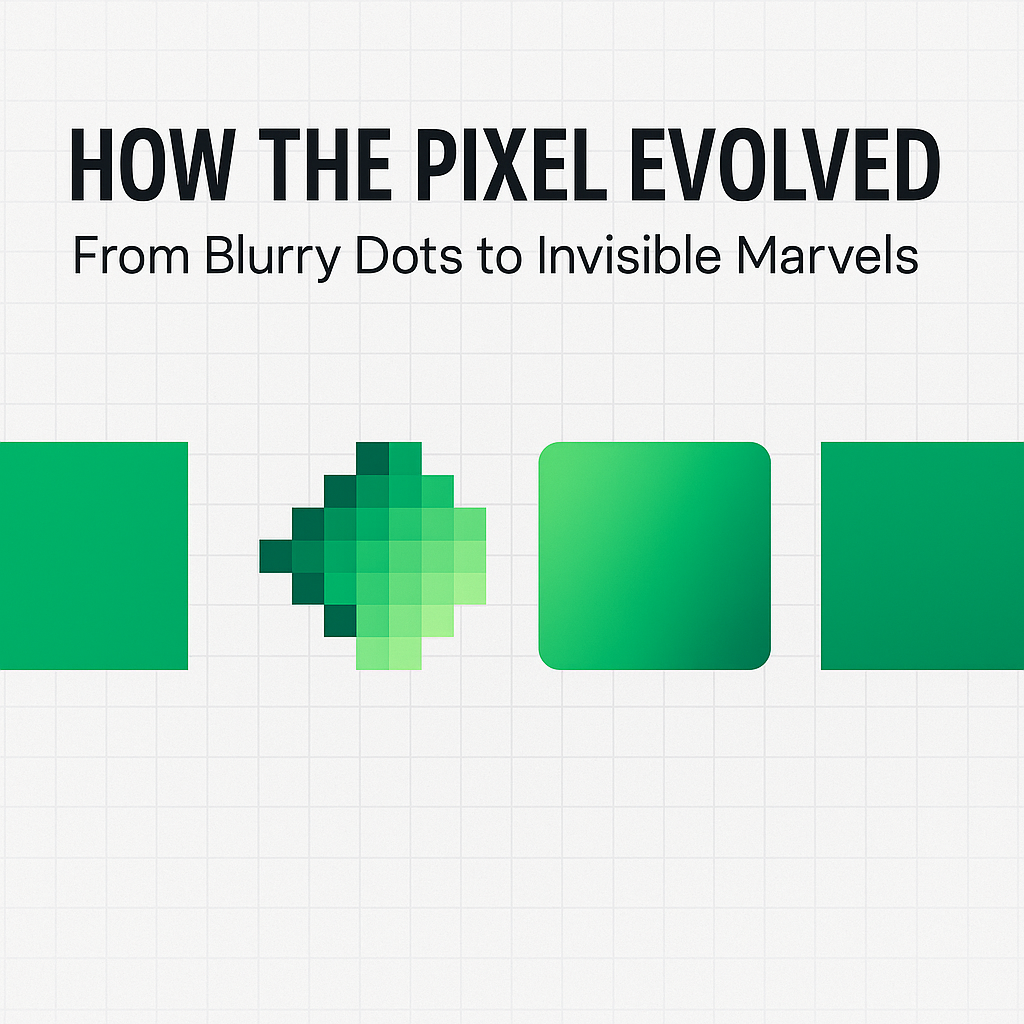
Have you ever stopped to think about what makes up the images on your screen?
That tiny dot of color you can’t even see anymore—that’s a pixel. It’s the most fundamental unit in the digital visual world, yet its journey from humble beginnings to high-tech invisibility is nothing short of fascinating.
Let’s rewind and explore how the concept of a pixel has transformed over the decades—and why it still matters more than ever today.
The Pixel’s Origin: Simple and Blocky (1960s–1980s)
In the early days of computing, the pixel was just that—a dot. It was the smallest addressable unit on a screen, and it wasn’t pretty.
- Early resolutions like 320×200 were the norm.
- Graphics were monochrome or offered a handful of colors (16 if you were lucky).
- CRT monitors and arcade games used pixels like LEGO blocks to create rudimentary visuals.
Pixels were visible, and that was part of the charm (or limitation).
The Color Boom: More Than Just a Dot (1990s)
Fast-forward to the ’90s, and pixels began to show off.
- Color depth improved: 256 colors, 16-bit, and eventually 24-bit “True Color”.
- Each pixel now held RGB values, giving artists and developers a real palette to work with.
- Bitmap graphics and pixel art defined early computer interfaces, games, and icons.
This was when the pixel became not just a dot, but a container of visual information.
The Subpixel Era & High-Definition Takeover (2000s)
With the rise of LCD displays, pixels got smarter—and sneakier.
- Every pixel now contained three subpixels (red, green, and blue).
- Technologies like ClearType used subpixels to sharpen text.
- HD resolution (720p, 1080p) became mainstream, making screens sharper than ever.
Pixels were still there—but they became harder to spot. The age of visible pixels was fading.
Retina, HiDPI, and the Invisible Pixel (2010s)
Then came the Retina Display.
Apple changed the game by marketing displays with such high pixel density that the human eye couldn’t tell the pixels apart.
- PPI (Pixels Per Inch) replaced raw resolution as the key metric.
- Designers began using logical pixels instead of physical ones.
- One CSS pixel might now span multiple device pixels.
This blurred the line between what a pixel is and how it’s perceived.
Modern Pixels: Abstract, Smart, and Everywhere (2020s)
Today, pixels exist in multiple layers—physical, logical, and perceptual.
- Your phone screen may have over 500 PPI—you literally can’t see the pixels.
- In web design, we talk about device-independent pixels (DIPs) for responsive layouts.
- In cameras, pixel size often matters more than count, especially in low light.
Whether it’s on your smartwatch, VR headset, or a 4K OLED TV, pixels shape your digital reality without you even noticing.
Full Circle: Why Pixels Still Matter
Even as they’ve become more abstract, pixels remain the foundation of everything visual in the digital world.
They’re:
- The building blocks of interfaces and images,
- The unsung heroes of responsive design and crystal-clear media,
- And the hidden storytellers behind every beautiful display.
Final Thought
Next time you swipe, tap, or stream, remember: the pixel is still there, quietly doing its job—even if you can’t see it anymore.
